
NYC Burglary Lawyer
NYC Burglary Attorney
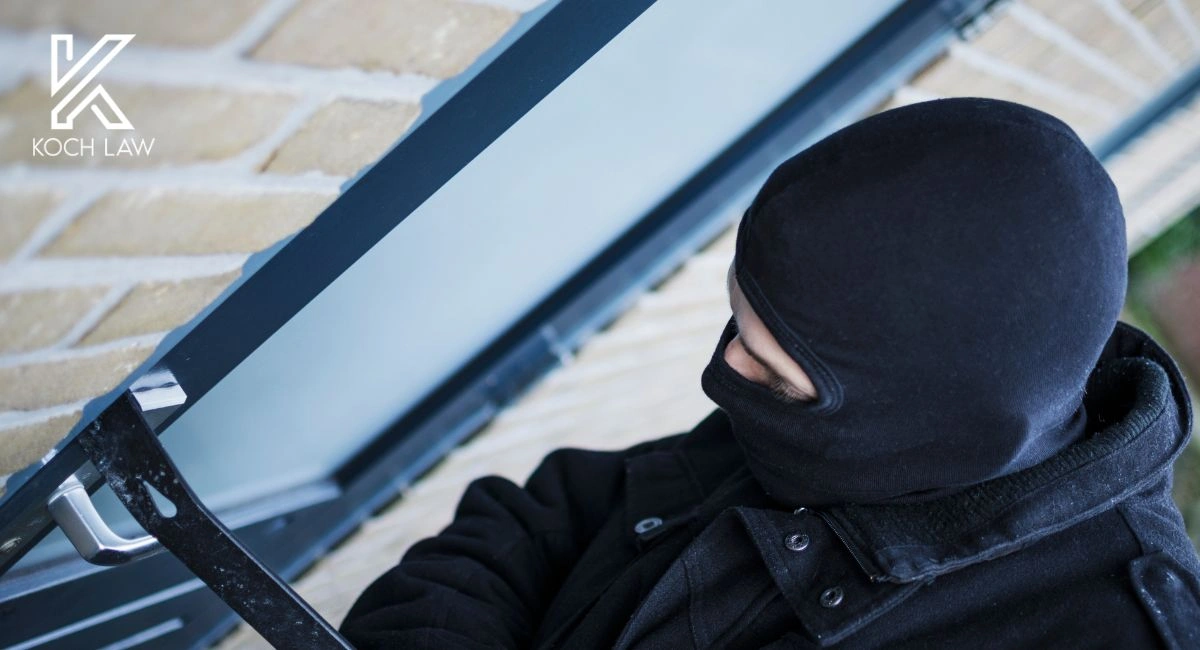
NYC is the largest city in the United States and can be considered an epicenter for crime. Burglary is considered a serious property crime in New York City. People convicted of burglary crimes may face prison time, have to pay fines, and may also have to pay restitution. If you are charged or convicted of a burglary crime in New York City, you should contact a NYC burglary lawyer to help you with your case.
Whether you committed the crime or you were wrongfully accused, your lawyer can be your first line of defense, navigating you through the legal process and ensuring the law is fairly and appropriately applied to your case.
Koch Law, PLLC is
located in the heart of Midtown
in New York City
Key Statutory Definitions
Burglary
Burglary is legally defined as the unlawful entry into a building, property, or structure with the intent to commit a felony or theft. The main factor for burglary is the intent to commit a crime; completion of the act or the manner in which a person does it can vary.
Building
The building, property, or structure could be a:
- House
- Apartment
- Trailer
- Barn
- Houseboat
- Office
- Structure
- Educational facility
- Vehicles or watercraft used for lodging or business
- Structure used for overnight lodging or business
Ultimately, the word “building” is broader than people might think under New York Penal Law. Under New York Penal Law § 140.00, a “building” for burglary purposes includes various structures and vessels beyond the standard understanding. Importantly, if a building has separately secured units, each unit can be considered a separate building.
Dwelling
In plain English, this is a building usually occupied at night. Under New York Penal Law § 140.00(3), a dwelling is a building that’s usually occupied by a person lodging there at night, and the core requirement is that the building is usually occupied at night for lodging. A resident does not need to be physically present at the exact moment of the crime for the structure to qualify as a dwelling.
If a building has both residential and commercial sections (like a storefront with apartments above), a burglary in the non-residential part may still be considered burglary of a dwelling. However, this may not apply if the area is inaccessible from the living quarters. This distinction is critical because entering a dwelling unlawfully with intent to commit a crime elevates the offense to second-degree burglary, which is a Class C violent felony.


Meet Your Attorney
Managing Attorney, Koch Law PLLC
Lee draws on his background as a former USAF intelligence specialist to bring precision and strategy to criminal defense in New York City. Whether you’re facing misdemeanor charges or serious felony indictments, he builds defense strategies designed to challenge evidence, protect your rights, and position you for the strongest outcome in court.
Enter or Remain Unlawfully
Under New York Penal Law § 140.00(5), a person “enters or remains unlawfully” when they are not licensed or privileged to be on the premises. In New York, entering a premises that’s open to the public is generally permissible unless the person defies a lawful order not to enter or remain.
However, entering an area “partly open to the public” may matter. For example, the front versus the back-of-house in a restaurant or bar can be a practical issue. Having permission to be in a part of a building that’s open to the public, or where the general public is invited, does not give you the right to enter non-public areas.
Classifying Burglary
Burglary is typically classified in three ways: forcible entry, unlawful entry (meaning no force), or attempted forcible entry. Examples of forcible entry can be kicking the door into someone’s home with the intention of stealing something. Unlawful entry can be walking into a gas station and stealing candy. An example of attempted forcible entry is when a person tries to kick in the door of a building, but they are unsuccessful.
Other examples of burglary include:
- Walking into an unlocked home and stealing or intending to steal a person’s personal item.
- Breaking the window of a convenience store and stealing from the cash register.
- Kicking in the door of a school, withdrawing a firearm, and attempting to steal school supplies from the utility closet.
- If someone was previously trespassed for shoplifting and they return, their return entry can be considered “unlawful.” If New York prosecutors allege the person returned with the intent to commit a crime, they may be charged with burglary, even though the store is normally open to the public.
- Someone enters a clothing store during business hours but walks through a door marked “Employees Only” into the back warehouse to steal merchandise. The moment they cross into that restricted stockroom with criminal intent, it becomes a third-degree burglary.
- In a deli or corner store, someone enters through a sidewalk cellar door or a back staircase leading to a basement used only for merchant storage. Since these areas are “only accessible to employees” and not the public, entering them is unlawful.
Under New York Penal Law § 140.00(5), if a building is partly open to the public, you are only licensed to be in the public portion. Entering any non-public part of that building without permission is legally equivalent to breaking into an entirely different building.
Types of Burglary Crimes in NYC
Burglary in the first degree: A class B felony where someone enters or remains in a dwelling, or a home, unlawfully and knowingly, and is also armed with a deadly weapon or explosive, causes physical injury to someone unassociated with the crime, uses or threatens to use a dangerous instrument, or displays a firearm.
Burglary in the second degree: A class C felony where someone knowingly enters or unlawfully remains in a building and is also armed with a deadly weapon or explosive, causes physical injury to someone unassociated with the crime, uses or threatens to use a dangerous instrument, or displays a firearm.
Burglary in the third degree: A class D felony that includes a person knowingly entering or unlawfully remaining in a building with the intention of committing criminal activity.
The biggest difference between first- and second-degree burglary is that first-degree burglary involves entering a person’s home, while second-degree burglary involves entering buildings or other structures that may not be personal dwellings.
What Are the Penalties for a Burglary Charge?
All burglary crimes are felonies in New York. However, the exact penalty or sentencing depends on the felony class. While your lawyer can inform you of the charges you may be facing, the table below provides a brief description of felony sentencing related to burglary:
- Class B felony – up to 25 years in prison
- Class C felony – up to 15 years in prison
- Class D felony – up to 7 years in prison
What Are Other Consequences of a Burglary Charge?
In addition to a prison sentence, a burglary charge will likely result in a criminal record. Having a criminal record may impede your ability to secure a job, housing, or immigration status. You can also face fines for your charge.
When Should I Contact a Lawyer?
You can consult with a lawyer in any phase of your burglary charge, but you may want to contact one as soon as you get arrested. It is wise to talk to your lawyer first about your charge instead of law enforcement or a prosecutor. Your NYC criminal defense lawyer at Koch Law can inform you of your rights and walk you through the legal process.
Depending on your case, your lawyer may also be able to negotiate your sentencing or reduce your fines. Lawyers can be invaluable in criminal cases that go to court because they can build a defense that stands up to the prosecution’s claims.
FAQs
How Much Does a NYC Lawyer Cost?
The cost of a lawyer in NYC depends on many factors. First, you should consider the experience of the lawyer and their success rate in similar cases, as this can impact their rates. Also, if your case is complex, your rates may be higher. Finally, the firm’s location can contribute to the ease of your working relationship and possible commute costs.
What Is the Sentence for Burglary in NYC?
The sentence for burglary in NYC depends on the details of the crime. The felony class depends on whether it is burglary in the first, second, or third degree. Burglary in the first degree is a class B felony with a sentence of up to 25 years, second degree is a class C felony with a sentence of up to 15 years, and third degree is a class D felony with a sentence of up to 7 years.
What Is the Most Serious Burglary Charge?
The most serious burglary charge is burglary in the first degree, which involves the unlawful entry or remaining in a person’s dwelling with the intent to commit a crime. It also includes having a deadly weapon, injuring an innocent third party, and displaying a firearm, among other crimes. It is a class B felony.
What Is Third-Degree Burglary in NY?
Third-degree burglary in New York is the lowest level of burglary. It involves a person unlawfully entering or remaining in a building with the intent to commit a crime. Unlike first- or second-degree burglary, it does not involve causing further injury to an individual. It is a class D felony, which means a perpetrator can be sentenced to up to 4 years in prison.
CALL NOW FOR A CONSULTATION
Hire a Burglary Lawyer—Contact Koch Law
If you or a loved one needs to hire a burglary lawyer serving NYC, call Koch Law. We take your burglary charge seriously at Koch Law. We understand burglary charges can be met with harsh consequences, so we are here to protect your rights and defend your case. If you need reliable assistance throughout the legal process for a burglary charge, contact us today for a consultation.
NYC Burglary Lawyer Reviews
★★★★★
“Lee and Paola are like a Michael Jordan and Scottie Pippen Duo. They are the best in the game. Quick replies, always there for you, honest and care about their clients. It’s more than just business for them, they really want to see you do well and give the best service possible. I would recommend them to anyone needing legal help as they are not just great at their job but also very good people. Was a pleasure working with them.” – Billy Pavlou
★★★★★
“Lee was a lifesaver! He helped me through a very difficult legal situation and explained things in a way that made it easy to understand. His impressive knowledge as an attorney is matched only by his compassion for people as human beings. If you are going through a tough time and looking for a lawyer who’s the best, Lee Koch is your ONLY choice!” – John Alexander
★★★★★
“Lee has an incredible ability to put you at ease, even in the toughest situations. He’s patient, thorough, and does an excellent job of explaining his thought process. I can’t recommend him highly enough!” – Matthew Firing
NYC Burglary Resources:

521 5th Avenue, 17th Floor, Suite 1712
New York, NY 10175

© 2026 Koch Law, PLLC All Rights Reserved.
*Images are obtained under license from Canva and other third-party stock image providers, with attribution included where required.
 ES
ES